It's been a few months since the last newsletter. I haven't done much writing these past six months since content has been almost exclusively podcasts/interviews for RCR, but I do have a few things planned in Right Minds the pipeline (mostly involving reading a lot of books first). To round out the year, I do have two war stories from each side of my family that I had a chance to collect back in May. The first one here is about the occupation and liberation of Friesland in World War 2.
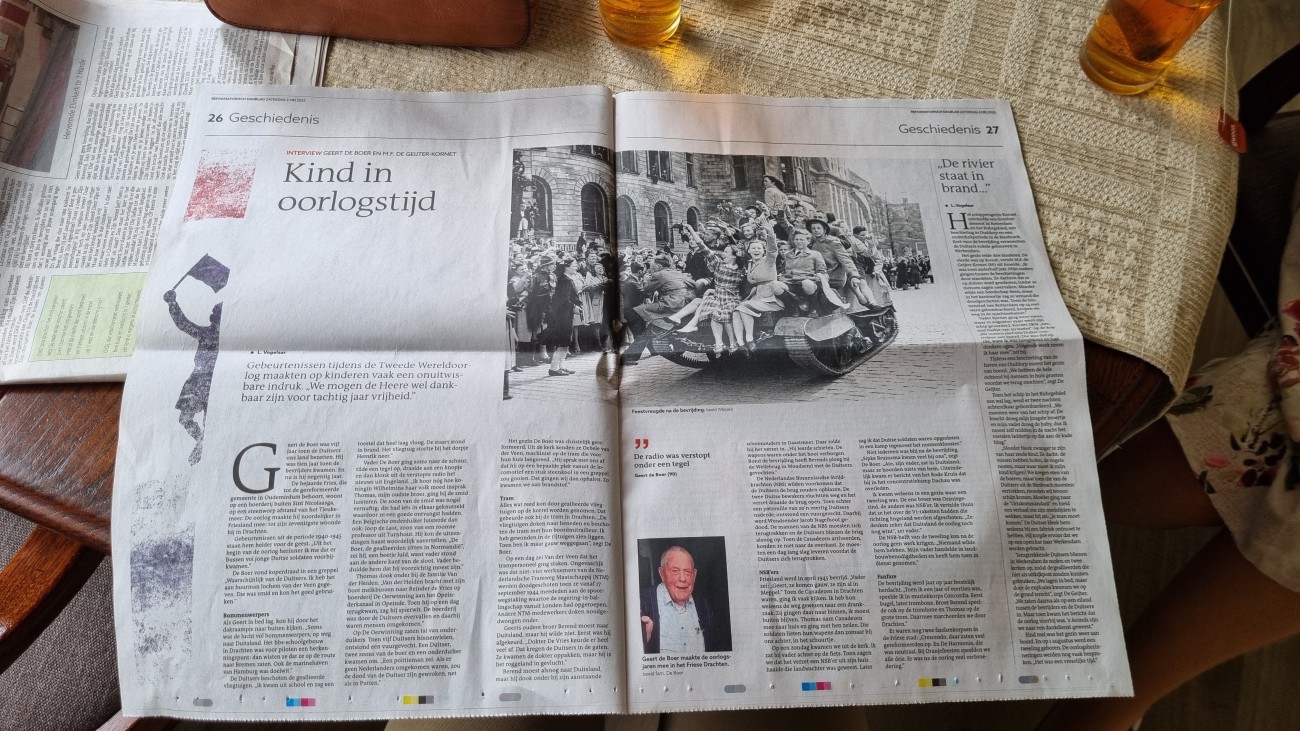
May 5th is "Liberation Day" in The Netherlands where the liberation of the country by the Canadian Armed Forces in 1945 is commemorated, 80 years ago this year. This interview is from the Reformed Daily, the largest Calvinist newspaper in the Netherlands.
The subject of the interview, Geert (90) is my great-great uncle. Berend in this story is my great-grandfather.
Child in wartime
Geert de Boer was five years old when the Germans occupied the Netherlands and ten years old when the liberators arrived. Today he is ninety years old.
The elderly Frisian, a member of the Reformed Congregation in Oudemirdum, lives on a farm just outside Sint Nicolaasga, a stone's throw from Lake Tjeukemeer. He spent the war years further north in Friesland and lived in Drachten until he was seventy. Events from the period 1940-1945 are still vivid in his mind. "At the very start of the war I remember busloads of young German soldiers driving past."
De Boer once found a length of copper wire in a ditch. "Probably dropped by the Germans. I gave it to our neighbour Jochem van der Veen. He was a blacksmith and could make good use of it."
Bombers
When Geert lay in bed he could look through the skylight. "Sometimes the sky was full of bombers on their way to Germany. The high school building in Drachten was a landmark for pilots: they knew they were on the route to Bremen. The naval port of Hamburg was also a target."
The Germans shot at the Allied planes. "I was leaving school one day and saw a plane flying very low. Its tail was on fire and it crashed near the village of Hemrik.”
Father de Boer sometimes went to the shed, lifted a tile, turned a knob, and the hidden radio would broadcast news from England. “I can still hear Queen Wilhelmina encouraging her people. Thomas, my eldest brother, went to the smithy to listen. The blacksmith's son was quite handy and had rigged something up that gave them good reception. A Belgian forced-labour evader listened too: Joop de Laat, son of a Roman-Catholic professor from Turnhout. He could almost repeat the broadcasts word-for-word. ‘De Boer, the Allies are in Normandy,’ he said, a bit loudly, because Father was standing on the other side of the ditch. Father signalled for him to be more careful.”
Thomas went into hiding with the Van der Heiden family. “Van der Heiden brought milk cans by boat to Reinder de Vries at 'De Oerwinning' farm on the Opeinde canal. He returned one day as pale as a ghost. The farm had been raided by the Germans and people had been killed.”
At De Oerwinning, they sheltered many forced-labour evaders. When five Germans burst in, a firefight broke out. One German, two of the farmer’s sons, and one draft evader were killed. “A policeman said: If no Dutch people had been killed, the German would have been avenged, just like in Putten1.”
The De Boer family belonged to the Christian Reformed Church. Through the church, they knew Oebbele van der Veen, a driver on the tram that passed in front of their house. “He arranged with us that he would throw a piece of coal from the locomotive into a ditch at a specific spot. We would go pick it up and that’s how we got fuel.”
Tram
Anything that moved could be strafed by Allied planes and the tram in Drachten was no exception. “The planes dove and sprayed at the tram with their machine guns. I saw wounded people lying in the carriage, so I left quickly,” says De Boer.
One day, Van der Veen said that the tram workers were going to strike. This was fraught with danger: four employees of the Netherlands Tramway Company (NTM) were shot dead when they participated in the railway strike of 17 September 1944, which the government-in-exile in London had called for. Other NTM employees were forced to go into hiding.
Berend
Geert’s older brother Berend2 was ordered to go to Germany for forced-labour, but he refused. At first, he was declared unfit. “Doctor De Vries exempted many men. When the Germans caught on to this they came to arrest the doctor, but he fled into the rye fields.”
Berend was told he still had to go to Germany, so he went into hiding with his future in-laws in Gaastmeer. There he joined the resistance. “He learned to shoot, they hid their weapons under the hay. During the liberation, Berend’s group fought the Germans at the Wellebrug in Woudsend.”
The Netherlands Internal Forces (NBS) wanted to stop the Germans blowing up the bridge. The two German guards fled and the resistance opened the bridge, but when a patrol of about forty Germans approached, a firefight broke out. Jacob Nagelhout from Woudsend was killed. The NBS resistance men had to retreat, and the Germans blew up the bridge anyway. When the Canadians arrived, they couldn’t cross and it took a day of fighting before the Germans retreated.
NSBers
Historical note: The "NSB" was the Dutch National-Socialist Movement, but any suspected collaborator was called an NSBer, equivalent to the English epithet "Quisling." The Calvinists and Roman-Catholics banned membership of the NSB in 1936 under penalty of excommunication, so most registered party members were Liberals. The label did not necessarily mean the accused played an active role in the occupation, but described anyone whose sympathies lay with the Germans rather than the House of Orange.
Friesland was liberated in April 1945. Father said: “Geert, they’ll be here soon, they’re already in Meppel.” When the Canadians were in Drachten I often went to watch them. I even showed them the way to a liquor store once. They went inside, but I had to stay outside. Thomas took Canadians home and went sailing with them. Those soldiers would just leave their weapons with us, in the shed behind the house.
One Sunday after church, as I was sitting on the back of father's bike, we saw the resistance drag an NSB’er out of his house who had been a member of the Landwacht3. Later I saw German soldiers locked up in a camp opposite the convent."
Not everyone was happy after the liberation. “Sipke Bruinsma visited us often,” says De Boer. “Ate, his father, was in Germany, but they heard nothing from him. Eventually a message came from the Red Cross that he had died in the Dachau concentration camp.
I sometimes visited a family with twins. One brother was a patriot4 and the other an NSBer. I told my family they were talking about the V1 rockets that were being launched toward England. ‘They must think Germany will still win the war,’ said father.”
The NSB twin couldn’t find work after the war. “No one wanted to hire him, but my father traded in farm supplies and took him on.”
Fanfare
The liberation was celebrated festively year after year. “When I was about fourteen I played in the Concordia band. First the bugle, later the trombone. Brother Berend also played trombone and Thomas the bass drum. Together we marched through Drachten.”
The Frisian town had two other brass bands: Crescendo, with many Reformed members, and De Harmonie, which was not religious. At Orange Festivals5 all three of us played. “There was a lot of camaraderie after the war.”
1. In Putten all 602 able-bodied men in the village were taken in a German reprisal. Only 48 returned home. Wikipedia link.
2. This Berend was my great-grandfather who passed away in 1997.
3. The "Landwatch" was a paramilitary organisation of collaborators who helped the Germans run checkpoints and arrest resistance members.
4. Literally: "loyal to the house of Orange".
5. "Orange Festivals" are national holidays which include King's Day and Liberation Day.
Today
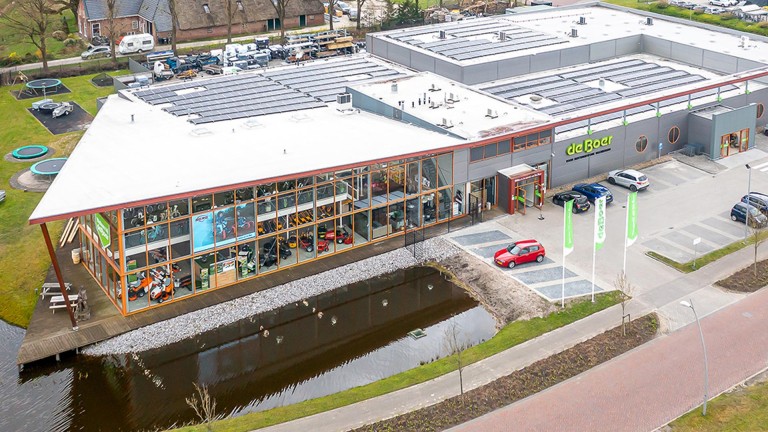
The family business (De Boer) mentioned in the article is still standing, although now much larger and located a few hundred meters from the original site. Ownership and management of the business went down one of my great-great uncle's side of the family and my own grandfather went into banking instead of staying in the family line of work: as most readers will already know, "boer" is Dutch for "farmer".